

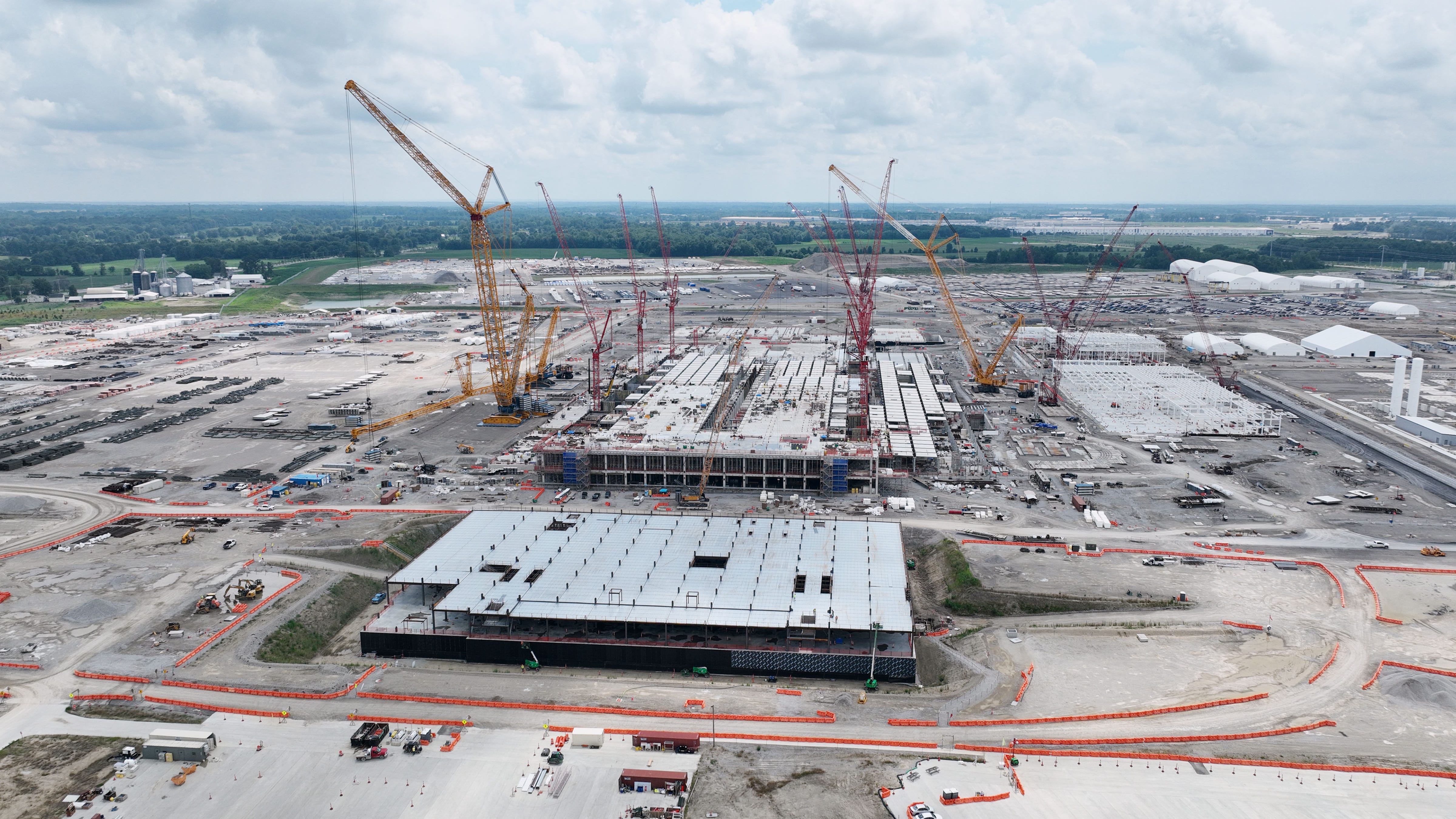

Intel continues construction work on New Albany site
Although extensive construction work continues at their New Albany, Ohio site, Intel has fallen behind some of its closest competitors and it will take a lot for the chip maker to catch back up with them, experts have told The Dispatch.
- Nvidia stake follows big investment from US government
- Nvidia’s $5 billion investment makes it one of Intel’s largest shareholders
- Intel-Nvidia partnership poses risk to TSMC and AMD
- Collaboration aims to enhance AI and computing capabilities
SAN FRANCISCO/WASHINGTON (Reuters) – Nvidia said on Sept. 18 it would invest $5 billion in Intel, throwing its heft behind the struggling U.S. chipmaker just weeks after the White House engineered an extraordinary deal for the federal government to take a massive stake in the company.
The deal, however does not address the root problem facing Intel’s construction project in central Ohio.
The stake will instantly make Nvidia one of Intel’s largest shareholders, giving it roughly 4% of the company after new shares are issued to complete the deal. Nvidia’s support represents a new opening for Intel after years of turnaround efforts failed to pay off, and it triggered a 25% jump in the U.S. manufacturer’s shares.
The company – once the chip industry’s flag bearer that claimed to put the “silicon” in Silicon Valley – appointed a new CEO, Lip-Bu Tan, in March. He quickly came under fire from U.S. elected officials, including President Donald Trump, who called for him to resign due to concerns about his connections with China. That led to a swiftly arranged meeting in Washington that ended with Intel’s unusual arrangement to give the U.S. a 10% stake in the company.
Nvidia CEO Jensen Huang told reporters on a call that the Trump administration had not been involved in the partnership deal but would have been supportive. Huang was seen with Trump and other business leaders during the U.S. president’s state visit to the United Kingdom on Thursday.
This new pact includes a plan for Intel and Nvidia to jointly develop PC and data center chips, but crucially will not involve Intel’s contract manufacturing business, known as a “foundry” in the chip industry, making computing chips for Nvidia. Intel’s foundry business will, however, supply the central processors and advanced packaging for the joint products. Huang said his company was continuing to evaluate Intel’s foundry technology and had been working with the rival for nearly a year.
Neither CEO addressed how the deal would affect Intel’s ambitious plan to invest $28 billion into two chip manufacturing facilities in the Licking County portion of New Albany. The project was originally slated to open this year, but Intel’s problems have forced that to be delayed until 2030 at the earliest.
Most analysts believe that for Intel’s foundry to survive, it would need to win a large customer such as Nvidia, Apple, Qualcomm or Broadcom.
“This may be the first step of an acquisition or breakup of the company (Intel) among U.S. chip makers though it is entirely possible the company will remain a shadow of its former self but will survive,” said Nancy Tengler, CEO of Laffer Tengler Investments.
Nvidia, whose must-have chips are powering a global artificial intelligence boom, said it would pay $23.28 per share for Intel common stock, slightly below the $24.90 Wednesday closing price but higher than the $20.47 price the U.S. government paid. Nvidia shares were up 3.8% on Thursday.
The companies did not disclose the financial terms of their collaboration but said they would make “multiple generations” of future products.
The deal adds to Intel’s growing reserve of capital, following a $2 billion investment from Softbank and the $5.7 billion investment from the U.S. government.
CEO Tan has vowed to make Intel’s operations lean and build factory capacity only when there is demand to match it.
“This is a massive game-changer for Intel and effectively resets its position of AI-laggard into a cog in future AI infrastructure,” said Gadjo Sevilla, senior AI and tech analyst at eMarketer.
Risks to TSMC, AMD
The pact represents a potential risk to Taiwan’s TSMC, which currently manufactures Nvidia’s flagship processors, a business the world’s most valuable company could one day extend to Intel. AMD, which competes with Intel for supplying chips to data centers, also stands to lose thanks to Nvidia’s backing.
TSMC declined comment; AMD did not respond to a request for comment.
“AMD has been seizing market share in desktops and laptops for quite some time and this will help Nvidia out against its closest domestic peers, but I think TSMC may have the bigger risk to its operation over the long term,” said David Wagner, portfolio manager at Aptus Capital Advisors.
Under the terms of the deal, Intel will design custom data-center central processors Nvidia plans to package with its AI chips, known as GPUs. A proprietary Nvidia technology will let the Intel and Nvidia chips communicate at higher speeds than before.
Speedy links are a key differentiator in the AI market because many chips must be strung together to act as one to chew through massive amounts of data. Currently, Nvidia’s best-selling AI servers with those links are only available using Nvidia’s own chips; this deal would put Intel on equal footing, giving it a chance to make money off each Nvidia server.
The combined Nvidia-Intel chips could challenge AMD, which is developing its own AI servers, and Broadcom, which also has chip-to-chip connection technology and helps companies such as Alphabet’s Google develop AI chips. Broadcom did not respond to a request for comment.
For consumer markets, Nvidia will provide Intel with a custom graphics chip that Intel can package with its PC central processors with the same speedy links, potentially giving it an edge against AMD.
The companies did not say when the first joint products would come to market, but said their product plans prior to the deal had not changed.
link