
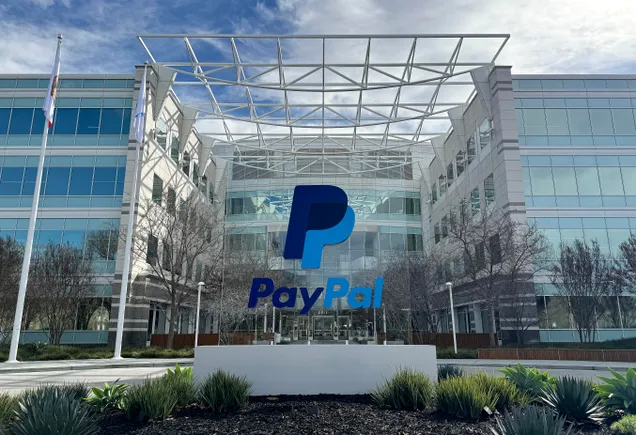
PayPal CEO Alex Chriss leads what may be the best known digital payments brand in the world, but he’s ready to move beyond that legacy.
PayPal solved the electronic payments problem long ago, and a pack of copycat competitors have made the business passé, he says. So, a year after taking the San Jose, California company’s top post, Chriss has set his sights higher: on making PayPal into the ultimate match-maker between merchants and consumers.
“We are going from what people thought of as just a payments company to really being a commerce platform, and that’s a big shift,” Chriss said in an interview last month. Chriss, 47, pictures PayPal helping merchants better pitch consumers in markets all over the world. He’s taken the first steps in that mission by remaking the management team; stirring up more innovation; and pushing the 26-year-old company to move faster, he says.
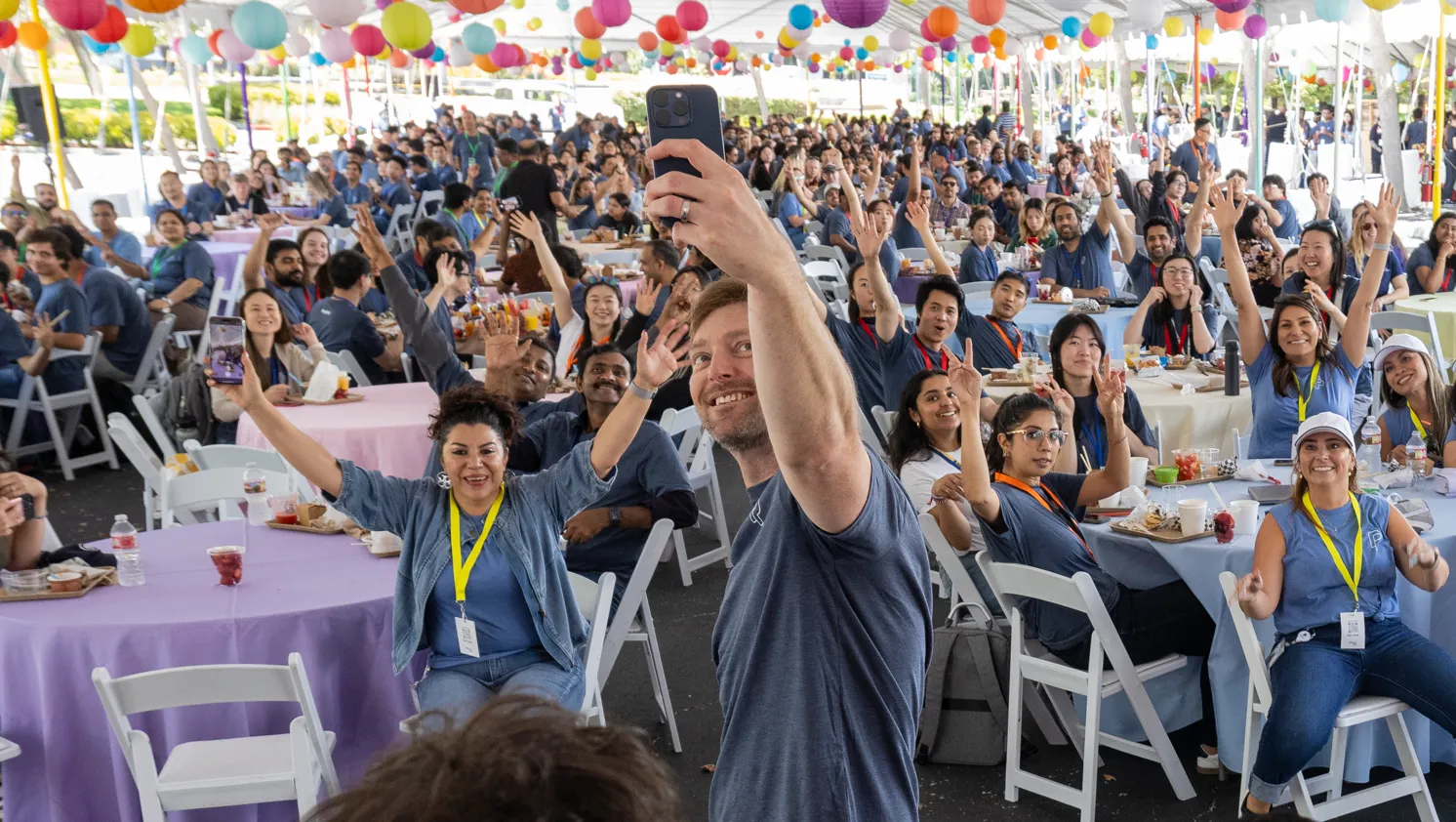
CEO Alex Chriss and employees
Permission granted by PayPal
Now, he’s focused on providing more services to merchants, and presumably attracting more of them as clients. He’s also counting on them driving a customized consumer experience.
His plan turns on PayPal’s hundreds of millions of consumer accounts and tens of millions of merchant accounts. “What we need to do is lean into the competitive advantage we have,” Chriss said. “They still have a challenge finding each other, creating personalized experiences and creating that commerce experience between them.”
A PayPal spokesperson declined to say how many of PayPal’s 432 million accounts belong to merchants.
Building its new commerce role
PayPal began as a consumer play, selling a secure means of making digital payments. A pack of soon-to-be very successful entrepreneurs founded the two businesses that became PayPal. That group, known as the “PayPal mafia” included billionaire businessman Elon Musk, venture capitalist Peter Theil and Affirm CEO Max Levchin, among others. For a time, the business was part of marketplace company eBay, but it was spun off in 2015.
Chriss’ predecessor, Dan Schulman, exited last year after struggling to spur growth, with the number of PayPal accounts stagnating after a surge during the early years of the COVID-19 pandemic. Schulman’s plans for a super app digital wallet also failed to materialize.
PayPal historically earned most of its revenue from fees that merchants pay for its branded transaction processing services. Since its acquisition of online payments gateway and processor Braintree in 2013, that unit’s white label services for retailers, including shoe-maker Nike and drugstore chain Walgreens, have also meaningfully bolstered revenue.
In addition, the company derives some fee income from services provided to consumers, including for some uses of its peer-to-peer payment app Venmo.
Chriss aims to sell a broader array of services to merchants. For instance, he’s tapping PayPal’s expanding trove of consumer transaction data to deliver valuable insights to retailers. If retailers have specific information about a consumer, like his shirt size or her color preference, they can digitally dangle better targeted ads and personalized promotions.
PayPal told users it’s changing its privacy policy, beginning next week, to mine more of their data, starting a day ahead of Thanksgiving, just before the holiday shopping season gets underway. Then, it will share that information with merchants starting next year.
“We will share information to help improve your shopping experience and make it more personalized for you,” the company said.
Drawing more merchants in
Chriss has also launched a new guest checkout service for merchants and processors called Fastlane. It facilitates payments when shoppers choose to check out online with an anonymous ‘guest’ option.
The service not only offers PayPal another revenue stream, it also allows the company to spot ‘guests’ who are PayPal users.
Other major processors that might have been considered competitors, including Atlanta heavyweight Fiserv and the fast-expanding Dutch company Adyen, have signed up to offer Fastlane services.
Fastlane shows how Chriss is unbundling services and building a bigger role for PayPal in the commerce arena, said Mizuho Securities analyst Dan Dolev, who follows the company.
“There’s a bigger opportunity here, which is for him to turn PayPal into more of a business-to-business provider and a software company using that two-sided network,” Dolev said in an interview late last month.
PayPal says it’s accepted in 200 markets worldwide, but Dolev notes there is still plenty of room for international growth.
Chriss is doing a “phenomenal job,” Dolev says now, but he wasn’t always a believer. In January, he downgraded his rating on PayPal’s stock to neutral, citing “intensifying competition in e-commerce checkout” and specifically a challenge from tech giant Apple.
Dolev has changed his mind, based on results PayPal is producing under Chriss, specifically reversing formerly flat or shrinking margins, and turning them positive. An analysis by Dolev’s team last month showed that PayPal’s e-commerce volume was growing faster than 14 top merchants, suggesting it isn’t losing share to rivals, Dolev said. He now has an “outperform” rating on the company.
To further elevate PayPal’s brand, Chriss launched a splashy ad campaign in September, featuring comedian actor Will Ferrell, to encourage consumers to use their PayPal accounts more often, whether in-store at checkout or online with a Venmo debit card.

PayPal’s new ad campaign with Will Ferrell
Courtesy of PayPal
Chriss’ early influences
As the son of a Levi Strauss marketing executive, Chriss learned early on how an iconic business pitches its brand. On his commutes to school with his father, he would listen to voice-mail messages his dad was playing out loud in the car to start his work day, Chriss said. His father’s role at the company also gave him a taste of the world at a young age, being born in Toronto, with temporary homes in the United Kingdom and Australia before his family, including a younger sister, settled in the San Francisco Bay area when he was 6.
His mother was a homemaker who taught him about empathy, making him better able connect with and lead employees, he says.
By his high school years in the 1990s, Chriss was tinkering with an early PC and bulletin board system, with encouragement from his maternal grandfather who was an admiral in the U.S. Coast Guard with some technology chops.
As a college student at Tufts University in the Boston area, he had a side hustle founding a business called CollegeWeb, an online community and entertainment hub for college students. By 1999, the year he graduated, the business was acquired by Youthstream Media.
That experience taught him early on what it was like to lead a small business. “You realize very quickly at 19-, 20-years-old what it feels like to be pressured when you’re trying to make payroll for people,” he said. “And so those are pretty formative experiences.”
Today, Chriss is married, with three sons of his own who keep him updated on the latest technology tools. As part of his effort to monetize Venmo, he sometimes invokes a son’s experience with the app at college.
An affinity for small businesses
CollegeWeb was the beginning of a long-time connection for Chriss to small businesses. He gravitated to the sector, including during 19 years at software-maker Intuit where he led the QuickBooks division focused on small businesses and self-employed professionals.
Chriss is now wooing SMB clients as a means of bolstering profit margins because the smaller clients tend to pay higher prices than their larger counterparts who are better positioned to negotiate lower prices.
At Intuit, Chriss found a mentor in Brad Smith, who eventually became CEO of the company. Smith, who retired from Intuit and is now president of Marshall University in West Virginia, said he put Chriss on a management fast-track because he saw in him an ability to identify employee talent; predict future trends; and hedge strategies by developing multiple solutions.
Not only did Smith support the younger executive’s rise at Intuit, he was likely influential in the PayPal board’s decision to hire the first-time CEO. Smith was a friend of PayPal’s board chairman at the time, John Donahoe, who has since exited.
“They all knew Alex, and it wasn’t just because of our friendship,” Smith said. “It’s because they had seen him in action. He had spoken at their events many times. They were partners in the marketplace.”
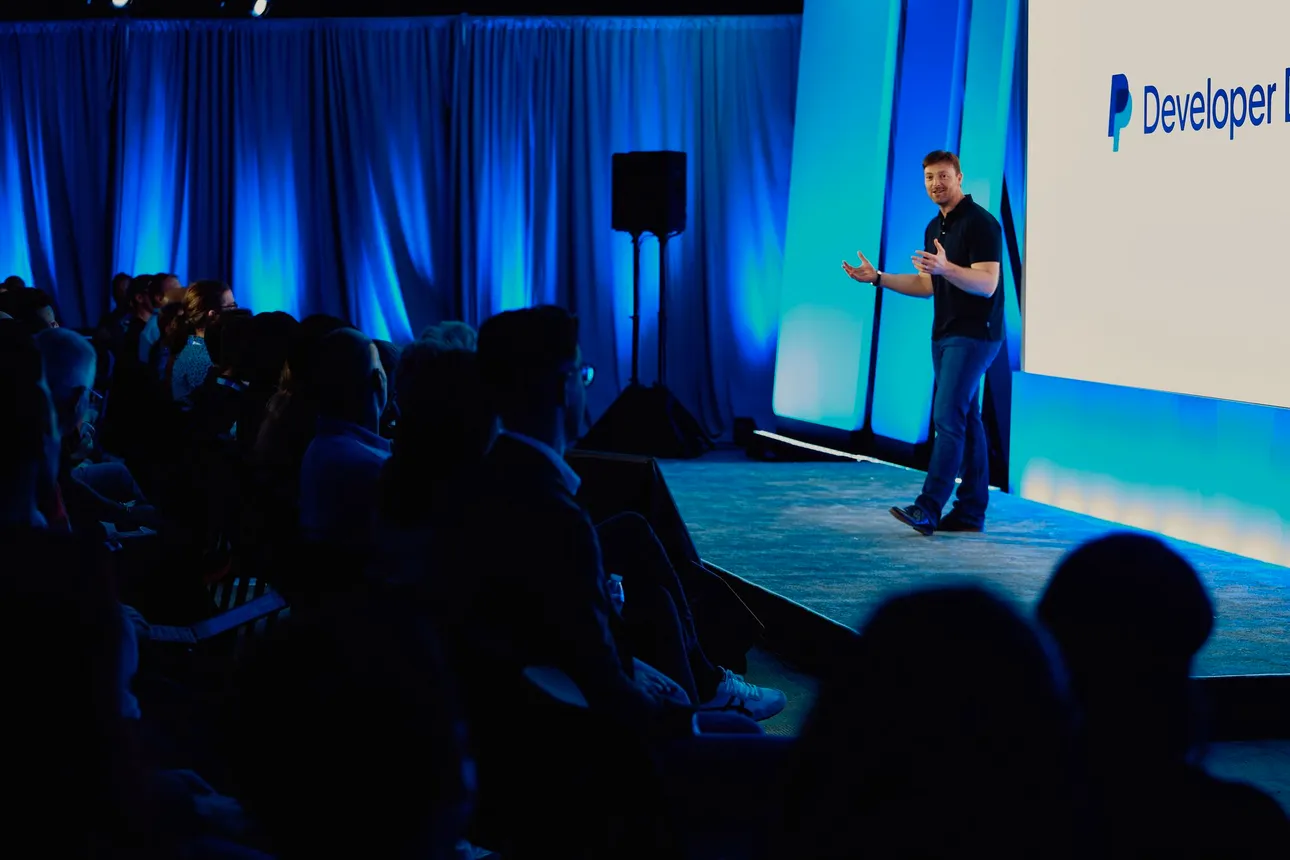
PayPal CEO Alex Chriss presenting
Permission granted by PayPal
Revising PayPal’s playbook
Within months of starting the job in September 2023, Chriss overhauled PayPal’s management team, installing Jamie Miller as chief financial officer and Isabel Cruz as chief people officer last November. This year, he hired Geoff Seeley as the company’s chief marketing officer in February. He’s also already cycling through some executives, appointing Srini Venkatesan as chief technology officer in June to replace Archie Deskus, who he had promoted to the post last November.
Tech issues are particularly critical to PayPal’s future. The company has grappled with persuading merchant clients to upgrade their technology systems so as to make PayPal’s digital services more consumer-friendly and convenient, particularly on mobile devices, said TD Cowen analyst Bryan Bergin, who follows the company. Only a small percentage of PayPal’s U.S. branded volume is on the latest version of its checkout technology, he said in an interview this month.
“It has been a long-term endeavor,” Bergin said. “What I would say is Alex has certainly put his foot on the gas.”
Still, he doesn’t expect Chriss’ new approach to make a significant difference until after next year.
Streamlining PayPal operations
Chriss has managed investor expectations to his advantage. In January, he led analysts and investors to expect that 2024 would be a transition year, but then pleasantly surprised them with better-than-anticipated financial results.
Net income for the first nine months of the year rose 6.4% to nearly $3.03 billion over the year-earlier period as revenue increased about 8% to $23.43 billion, according to the company’s latest quarterly filing. PayPal shares have rallied, climbing by about 46% just since July 1.
A key part of Chriss’ strategy is jettisoning ancillary assets that are not essential to PayPal’s core business, including the main branded business; the unbranded Braintree operation; and the underdeveloped Venmo unit.
After Chriss arrived, PayPal sold its Happy Returns business last year, and the CEO has said he’s mulling other assets for divestment.
Last month, the company shut down an online fundraiser tool that didn’t seem to have attracted a broad following.
He’s slimmed down the workforce too. In January, the company cut 9% of the company’s workforce, or about 2,500 of its then 27,200 employees.
Creating a global open ecosystem
Despite gains, the biggest impediment to PayPal’s success remains the ever-expanding barrage of digital payment competition. The rivals range from tech giants Apple and Google to new entrants like small business specialist Stripe and buy now, pay later innovator Klarna.
“The concerns have been structural share loss to alternative payment methods, as well as just demographic dynamics,” said Bergin, who has a ‘hold’ rating on the company. If PayPal can prove it’s’ “renewing and driving new relationships with younger consumers, I think that certainly would push back against the current cautious case.”
Ultimately, Chriss contends any would-be rivals don’t have the same powerful positioning on both sides of the commerce equation that PayPal has.
His vision for PayPal almost sounds a bit like the commerce nexus that Amazon has become. But Chris says PayPal’s reach won’t be limited by a closed system.
“We are one of the few ubiquitous, neutral platforms,” Chriss said. “We’re global, and we’re enabling commerce to happen across any consumer, and any merchant, anywhere in the world. And I think that is a unique element of PayPal.”
Correction: The story has been updated to correct the percentage increase in the stock price.
link