
Previous research on the adoption of mobile payment systems
Previous studies have extensively examined the factors influencing the adoption of mobile-based payment services (Chakraborty et al., 2022; Singu & Chakraborty, 2022). Various information system theories and models are introduced to explain the behavioral intention of consumers to adopt new technologies (Chakraborty et al., 2023; Chakraborty, 2023; Verma et al., 2023), especially with respect to digital payment apps (Aliu, 2024; Belmonte et al., 2024). By applying the technology acceptance model (TAM), previous studies have suggested that perceived ease of use and perceived usefulness significantly influence customers’ intention (Hasan et al., 2021; Nelwan et al., 2021; Norng, 2022). However, TAM was limited in certain aspects, and more factors had to be added to explain the adoption behavior thoroughly (Belmonte et al., 2024; Putri et al., 2023). Some studies used an extended version of the TAM model by including factors, such as trust and perceived enjoyment (To & Trinh, 2021), data security and privacy (Putri et al., 2023), subjective norms (Gumussoy et al., 2018), observability and social image (Yang et al., 2023). These additional factors demonstrated a significant effect on the intention to adopt technological advancements. The UTAUT model was introduced by Venkatesh et al. (2003) to understand the adoption intention factors. The UTAUT model and its variants are most frequently employed to examine the intention and behavior toward UPI adoption (Kuriakose et al., 2022a; Ranpariya et al., 2021; Saha & Kiran, 2022; Shah, 2021; Sinha & Singh, 2023) and e-money services (Giri et al., 2019). The UTAUT model has 70% more prediction efficacy than the TAM (Gupta et al., 2023). The outcome variables are behavioral intention and continuous use of the technology being adopted. Under the UTAUT model, existing studies showed that performance expectancy (Oliveira et al., 2016; Patil et al., 2020a; Shaikh & Amin, 2023), effort expectancy (Khalilzadeh et al., 2017; Upadhyay et al., 2022), social influence (Hamzah et al., 2023; Yan et al., 2023) and facilitating conditions (Hassan et al., 2023) significantly influence adoption intention of mobile payments. However, contradictory studies showed no influence of these variables on consumer intention (Alkhwaldi et al., 2022; Bajunaied et al., 2023; Kurniasari et al., 2022). Recent studies have utilized the UTAUT 2 model by including factors, such as price value, hedonic motivation, and habit (Migliore et al., 2022; Tang & Tsai, 2024; Wu & Liu, 2023). Empirical studies extended the UTAUT and UTAUT 2 models to comprehend the significant drivers impacting the behavioral intention to adopt mobile payment systems by adding factors and theories, such as avoidance and ownership (Yang et al., 2023), awareness, security, and privacy (Al-Okaily et al., 2024), perceived trust (Gupta et al., 2023), perceived enjoyment (Nur & Panggabean, 2021), and uncertainty avoidance (Alkhwaldi et al., 2022). Apart from using TAM and UTAUT models in explaining the intention of adopting mobile payment systems, few studies have used the theory of consumption values (Chakraborty et al., 2022; Karjaluoto et al., 2021), which has depicted a significant influence on mobile payment adoption. Although the UTAUT model has been extensively used to explain mobile payment adoption behavior, it is criticized for not including variables addressing individual differences (Patil et al., 2020b; Razi-ur-Rahim et al., 2024). In addition, the impact of factors such as add-on services or promotional benefits provided by the service providers is not studied in the context of Indian UPI users (Kuriakose et al., 2022b). Besides, the true effect of promotional benefits on consumers’ behavior often remains unnoticed, as it is not observed from the consumers’ perspective. Furthermore, studies on the role of demographic factors in UPI adoption are less studied and are contradictory (Banerjee & Pradhan, 2024; Chauhan et al., 2022).
Conceptual model and hypotheses development
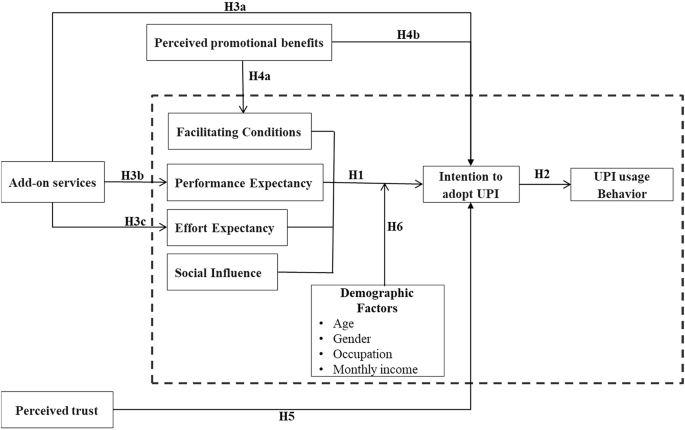
Figure 1 presents the conceptual framework for the study. This study is based on the UTAUT model to examine the factors influencing adoption intention. The model is expanded to include perceived trust, perceived promotional benefits, and add-on services provided by UPI to consumers. The UTAUT theory, as suggested by Venkatesh et al. (2003) and its variants, behavioral intention refers to the psychological state that indicates one’s readiness or plan to engage in a specific behavior (in this case, using UPI). This intention serves as a precursor to actual behavior, whereas UPI usage behavior pertains to the tangible adoption and incorporation of the technology into routine financial transactions (Jha & Kumar, 2020; Shah, 2021). Furthermore, the theory proposes the moderating role of demographics on the impact of the UTAUT factors on the behavioral intention to adopt. When applied in the context of UPI, it was found that facilitating conditions imply the degree to which an individual user believes that organizational and technical infrastructure will support the usage of UPI, while performance expectancy is the degree to which the consumer believes that the use of UPI will help in enhancing their performance (Jena, 2023; Kuriakose et al., 2022a). Effort expectancy refers to the perceived ease of using UPI, while social influence pertains to the extent to which individuals believe that significant others expect them to adopt UPI. All four factors are expected to have a significant positive impact on the consumers’ behavioral intention of adopting UPI (Gulia & Singh, 2023; Kuriakose et al., 2022a). On the contrary, facilitating conditions (Ranpariya et al., 2021; Saha & Kiran, 2022) along with effort expectancy (Gulia & Singh, 2023; Saha & Kiran, 2022) or social influence (Gulia & Singh, 2023; Jha & Kumar, 2020), were found to be insignificant for the consumers’ intention to adopt UPI. In the study of Gupta et al. (2022), none of the four factors were found to be statistically impacting behavioral intention. Therefore, with such varying responses, it becomes critical to validate each factor in the current context. Based on this, the first hypothesis, H1: The factors of the UTAUT model (facilitating conditions, performance expectancy, effort expectancy, and social influence) significantly influence the intention to adopt UPI, constituting several sub-hypotheses individually testing their adoption intention, was proposed.

Proposed conceptual model developed for the study for assessing UPI adoption and usage.
H1a: Facilitating conditions substantially boost UPI adoption by consumers.
H1b: Performance expectancy positively influences UPI adoption.
H1c: Effort expectancy leads to enhanced UPI adoption by consumers.
H1d: Social influence significantly dictates the adoption of UPI by consumers.
The UTAUT theory also implies that the behavioral intention towards the adopted technology will directly impact the actual usage and adoption. This has been reported to be true in the context of UPI, where intention has been found to drive the usage behavior of UPI users (Gupta et al., 2022; Saha & Kiran, 2022). A strong intention will most likely lead to the actual usage of the UPI mode of payment. Moreover, the prior experience of UPI usage positively influences the usage of Central Bank Digital Currency (CBDC) (Gupta et al., 2023). Therefore, to validate the impact of the behavioral intention of UPI adoption on actual usage in the current context, the next hypothesis was formulated as follows:
H2: The intention to adopt UPI dictates the UPI usage behavior.
According to Kuriakose et al. (2022b), the add-on services imply the supplementary services and functionalities that are provided alongside the core UPI payment services. In the current context, these services extend beyond basic money transfers, improving users’ experience and providing added value to them. Such services include bill payments, mobile and direct-to-home TV services, QR code payments, loans and credit facilities, investment and financial services, subscriptions, auto payment, account balance checks, account history, mini statements, merchant offers, cashback, split bills, etc. Based on this, the next hypotheses intend to validate the following.
H3a: The add-on services provided by UPI directly influence the intention to adopt UPI among consumers.
It is believed that add-on services provided by UPI improve performance expectancy by expanding the platform’s utility beyond the simple payment functions by increasing utility and versatility, saving time, facilitating convenience, rendering promotional offers, and offering cashback benefits (Dhivya et al., 2023; Kuriakose et al., 2022a). Thus, it can be expected that add-on services will have a certain impact on the performance expectancy of UPI (Kuriakose et al., 2022a). To test this, the following hypothesis was formulated,
H3b: The add-on services provided by the UPI significantly enhance the performance expectancy of UPI.
Apart from improving performance, add-on services may improve effort expectancy by simplifying multiple functions and making the platform more user-friendly through centralized platforms, seamless integration, user-friendly features, intuitive design, and support (Kuriakose et al., 2022a). Providing incentives and automating tasks can increase perceived value and ease of use. Based on this, the next hypothesis was proposed,
H3c: The add-on services also improve the effort expectancy of UPI.
Promotional benefits can be described as the “financial incentives” provided to attract potential users and retain them (Kuriakose et al., 2022a). Such benefits include cashback, coupons, discounts, and rewards, which are offered to users (Khanra et al., 2020). These perks can motivate users to ensure the availability of the necessary conditions at both technical and operational levels and enable compatibility of their devices. The perceived availability of support and assistance will strengthen the perceived facilitating conditions. Therefore, the next hypothesis validates this relationship.
H4a: The perceived promotional benefits provided by UPI have a significant impact on the facilitating conditions.
Promotional benefits tend to increase the perceived financial value to users, reduce perceived risks, induce positive reinforcement, encourage social influence, boost trust, and incentivize repeat usage. All of these factors collectively make mobile payment adoption more attractive and economically efficient, thereby providing a competitive edge to users and capturing their attention (Al-Saedi et al., 2019; Kukreja et al., 2020). It has been proposed that promotional benefits may positively influence the intention of UPI adoption (Jha & Kumar, 2020; Kuriakose et al., 2022b; Shah, 2021). To validate that in the current context, the next hypothesis was proposed.
H4b: The perceived promotional benefits provided by UPI significantly lead to the intention to adopt UPI.
Perceived trust seems to have a direct influence on the willingness of users to adopt digital payments, as it tends to reduce perceived risks, decrease transaction anxieties, and increase confidence in the reliability of transaction systems, banks, regulatory framework, and app providers (Khan & Abideen, 2023; Manrai & Gupta, 2020). Perceived trust was found to influence the adoption of e-banking among the aged population (Jena, 2023). This leads to the cultivation of positive experiences, which would gradually result in sustainable usage (Al-Saedi et al., 2020). Hence, we hypothesized that:
H5: Perceived trust in UPI tends to significantly influence the adoption intention of consumers.
One of the major factors that influences the usage of UPI among users is demographics (Patel & Datta, 2020). Significant differences have been observed in the adoption of UPI based on demographics, such as age, gender, monthly income, and occupation (Tungare, 2019). The adoption of UPI was much higher in males compared to females and adults over young adults. As a part of the UTAUT theory, as suggested by Venkatesh et al. (2003), demographic factors such as age, gender, education, experience, and voluntariness have been proposed to influence adoption and subsequent usage. However, it was found that neither age nor gender moderated the impact of performance expectancy on behavioral intention to adopt e-money services in Indonesia (Giri et al., 2019) or e-banking services, including UPI in India (Ranpariya et al., 2021). Therefore, for the present study, age, gender, income, and occupation were considered under demographics.
H6: Demographic factors considerably moderate the impact of UTAUT factors on the adoption of UPI.
link